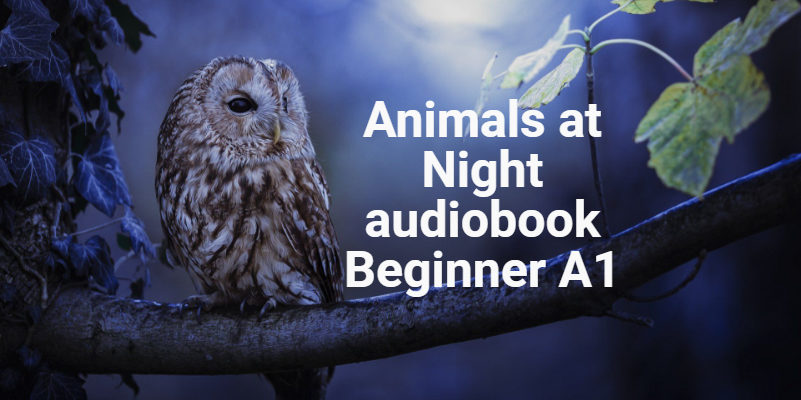
Animals at Night audiobook Beginner A1. “Animals at Night” audiobook in English, Level 1 read and listen in English with parallel translation (bilingual).
“Animals at Night” is a story in English, Beginner A1 level (about 400 unique words).
Book summary, click to open
A series of educational stories in English for Beginner A1 learners about the world around us. By Rachel Bladon. This part is dedicated to the nocturnal animals that inhabit our planet.
Life at night.
When the sun goes down, it gets dark and the air gets a lot colder.
For many people, it’s time to go to sleep.
But a lot of animals only come out at night.
They are called nocturnal animals.
The apossum is a nocturnal animal.
At night, it looks for plants and small animals to eat. In the day, it hides and goes to sleep. Discover >> the armadillo is a nocturnal animal and it sleeps for more than 17 hours in the day.
Nocturnal animals aren’t the only animals that come out at night.
Some animals like the tiger come out in the day and at night.
Other animals like the rabbit only come out in the morning when it’s getting light and in the evening when it’s getting dark.
Some animals come out at night because there are not so many predators, animals that want to hunt and eat them.
Some animals find more food because they eat other animals that come out at night.
In very hot places, it’s sometimes too hot to come out in the day.
Chapter 2. Special senses.
Many animals that come out at night have special senses.
This means that they can see, hear, touch, smell, or taste very well.
These special senses help them to find food and to stay safe in the dark.
Wild dogs, like foxes, usually hunt in the dark.
They have a big nose and an amazing sense of smell that helps them to find food.
A fox can smell mice through up to 12 cm of snow.
Foxes also have very big ears that they can move, so they can hear very well all around them.
Raccoons are nocturnal animals that have long fingers and a very good sense of touch.
When they are hunting for food in water, they use their fingers to find fish and frogs.
Many nocturnal animals can see much better than people in the dark.
They have very big eyes that let in lots of light.
A tarscier’s eye is bigger than its brain. It can see very well in the dark.
Chapter 3.
Flying at night.
In the day, owls stay in trees or buildings, but at night they hunt for food.
Owls can see very well in the dark and they also have an amazing sense of hearing.
They listen for little noises from their prey. Rabbits, mice, and other small animals that they like to eat.
Then they fly down and catch them in their sharp claws.
Many owls have soft feathers on their wings.
So they can fly very quietly.
Their prey don’t know that they are coming.
Most types of bat are nocturnal.
At night they look for fruit and flowers or they hunt for insects, fish, and mice.
Bats can see and smell very well. And many bats have a special sense called echolocation.
This helps them to find food in the dark.
Bats make special noises when they fly.
The noises bounce off things and come back as echoes.
These echoes tell bats where things are and how big they are.
In the day, bats hang upside down and stay in caves, trees, and buildings.
Chapter 4.
Ocean animals.
Some fish live near the top of the ocean in the day and then they swim down to the deep ocean at night.
Other fish swim up to the top of the ocean at night and they look for plankton.
Very small animals that swim up to the top of the ocean every evening to find food.
Plankton are food for fish like the lantern fish.
The lantern fish stays down in the deep ocean in the day, but when the sun goes down, it swims to the top of the ocean.
It feeds near the top of the ocean at night and then swims back down before morning. The lantern fish has lights on its body when it swims.
The white tip reef shark also comes out at night. It stays in caves down in the deep ocean in the day and doesn’t move very much. Then at night, it comes out to hunt for fish and octopuses.
Chapter 5.
Mini beasts.
Many mini beasts like moths and spiders come out at night.
Many beasts come out at night because there are not so many predators that hunt and eat them.
Slugs and snails look for food at night because the sun can dry them out in the day.
Moths are insects.
They have a body that’s good for living at night.
They have special antenna on their head.
These help them to look for food and to find their way in the dark.
Moths also have patterns on their wings that help them to hide in trees in the day.
Tarantulas are spiders.
They hunt for their prey at night.
Special hairs on their body help them to feel when another animal is near.
They hide and then they jump on their prey and put poison in its body.
Nocturnal fireflies make lights in their body that turn on and off at night.
[snorts] They use these lights to communicate.
Chapter 6.
Desert animals.
In many deserts, it’s very hot in the day, so many animals only come out at night.
The fenic fox lives in the Sahara Desert in Africa.
It stays in a burrow in the sand in the day, and at night, it hunts for mice.
lizards and insects.
It’s the smallest fox in the world, but it has very big ears, so it can easily hear its prey in the dark.
Kangaroo rats don’t need to drink. They get water from the seeds that they eat.
Kangaroo rats live in deserts in North America.
At night, they jump around and find seeds.
They keep seeds in their mouth, and then they put them in their burrow.
Desert scorpions stay out of the sun in the day.
At night, they come out to feed on mini beasts.
Scorpions can’t see well, but they have special hairs on their legs so that they can feel when prey is near.
They kill their prey with a sting from their tail.
Chapter 7.
African animals.
There are many nocturnal animals in Africa.
Many big cats, like leopards, hunt for food at night.
It’s usually easier to catch prey when it’s dark and when it’s cooler, too.
Big cats see very well, and they have a very good sense of hearing and smell, so they are good night hunters.
Their eyes have a special part called the topum.
The depedum reflects light so that the cats can see in the dark.
It can make their eyes glow.
Arvarks can’t see very well, but they have a big nose and big ears that they use to find ant nests at night.
They dig up the nests and catch the ants on their sticky tongue.
An arvark can eat 50,000 insects in one night.
Hippos come out at night to eat grass.
In the day, they stay in water because their skin needs to be wet and cool.
Bush babies hunt for food at night.
They use their big eyes to look in trees for insects, flowers, seeds, and eggs.
Chapter 8.
Animals asleep.
At night, when many animals are looking for food, others are asleep, just like you.
In the evening, baboons climb up cliffs or into the tops of trees, and they sleep for about 10 hours every night.
In these high places, they know that they are safe from predators.
Flamingos sleep at night standing on one leg.
They have special ankles that keep their legs straight so that they don’t fall down.
Walruses live in the Arctic.
It’s light all night in the summer there.
Walruses sleep on land, on ice, or in water.
They can sleep for up to 19 hours.
Walruses have special pouches on their body. When they sleep in water, they put lots of air in the pouches to keep their head above the water.
Walruses sometimes put their tusks over big pieces of ice so that they don’t move away when they are asleep.
Chapter nine.
Noises at night.
It’s hard to see at night, so animals often use noises to communicate.
Owls call to each other, and lions roar if predators come near their babies.
When deer are in danger, they try to communicate with other deer.
They make noises in their nose and they hit the ground with their feet.
Most birds do not sing at night, but the male nightale sings a beautiful song when it’s looking for a female.
Some insects make a lot of noise at night, too.
The grasshopper makes noises with its wings and legs.
The Tasmanian devil is a small animal that comes out to hunt for food in the dark.
When it’s scared or it thinks that another animal is going to take its food, it makes terrible noises.
When howler monkeys call to each other at night, you can hear them from about 5 km away.
Chapter 10.
Traveling at night.
Every year, many types of bird migrate.
They move from one place to another to live.
These birds usually only come out in the day, but when they migrate, they travel at night.
This is because they are safer from predators and they can fly for longer because it’s cooler.
Also, they feed in the day and then they have lots of energy to fly at night when they are full of food.
Green turtles are not usually nocturnal, but they travel at night when they are ready to lay their eggs.
They swim to a beach and come out of the ocean.
They wait until night when it’s cooler.
Then they move up the beach and lay their eggs in the sand.
When the baby turtles come out of the eggs, they dig their way out of the sand and they go to the ocean.
The baby turtles do this at night when it’s cooler. And when there are not so many predators, there’s a lot happening at night.
All around the world, millions of animals are moving around, hunting for food, and traveling from one place to another.
Life at night.
When the sun goes down, it gets dark and the air gets a lot colder.
For many people, it’s time to go to sleep.
But a lot of animals only come out at night.
They are called nocturnal animals.
The apossum is a nocturnal animal.
At night, it looks for plants and small animals to eat. In the day, it hides and goes to sleep. Discover >> the armadillo is a nocturnal animal and it sleeps for more than 17 hours in the day.
Nocturnal animals aren’t the only animals that come out at night.
Some animals like the tiger come out in the day and at night.
Other animals like the rabbit only come out in the morning when it’s getting light and in the evening when it’s getting dark.
Some animals come out at night because there are not so many predators, animals that want to hunt and eat them.
Some animals find more food because they eat other animals that come out at night.
In very hot places, it’s sometimes too hot to come out in the day.
Chapter 2. Special senses.
Many animals that come out at night have special senses.
This means that they can see, hear, touch, smell, or taste very well.
These special senses help them to find food and to stay safe in the dark.
Wild dogs, like foxes, usually hunt in the dark.
They have a big nose and an amazing sense of smell that helps them to find food.
A fox can smell mice through up to 12 cm of snow.
Foxes also have very big ears that they can move, so they can hear very well all around them.
Raccoons are nocturnal animals that have long fingers and a very good sense of touch.
When they are hunting for food in water, they use their fingers to find fish and frogs.
Many nocturnal animals can see much better than people in the dark.
They have very big eyes that let in lots of light.
A tarscier’s eye is bigger than its brain. It can see very well in the dark.
Chapter 3.
Flying at night.
In the day, owls stay in trees or buildings, but at night they hunt for food.
Owls can see very well in the dark and they also have an amazing sense of hearing.
They listen for little noises from their prey. Rabbits, mice, and other small animals that they like to eat.
Then they fly down and catch them in their sharp claws.
Many owls have soft feathers on their wings.
So they can fly very quietly.
Their prey don’t know that they are coming.
Most types of bat are nocturnal.
At night they look for fruit and flowers or they hunt for insects, fish, and mice.
Bats can see and smell very well. And many bats have a special sense called echolocation.
This helps them to find food in the dark.
Bats make special noises when they fly.
The noises bounce off things and come back as echoes.
These echoes tell bats where things are and how big they are.
In the day, bats hang upside down and stay in caves, trees, and buildings.
Chapter 4.
Ocean animals.
Some fish live near the top of the ocean in the day and then they swim down to the deep ocean at night.
Other fish swim up to the top of the ocean at night and they look for plankton.
Very small animals that swim up to the top of the ocean every evening to find food.
Plankton are food for fish like the lantern fish.
The lantern fish stays down in the deep ocean in the day, but when the sun goes down, it swims to the top of the ocean.
It feeds near the top of the ocean at night and then swims back down before morning. The lantern fish has lights on its body when it swims.
The white tip reef shark also comes out at night. It stays in caves down in the deep ocean in the day and doesn’t move very much. Then at night, it comes out to hunt for fish and octopuses.
Chapter 5.
Mini beasts.
Many mini beasts like moths and spiders come out at night.
Many beasts come out at night because there are not so many predators that hunt and eat them.
Slugs and snails look for food at night because the sun can dry them out in the day.
Moths are insects.
They have a body that’s good for living at night.
They have special antenna on their head.
These help them to look for food and to find their way in the dark.
Moths also have patterns on their wings that help them to hide in trees in the day.
Tarantulas are spiders.
They hunt for their prey at night.
Special hairs on their body help them to feel when another animal is near.
They hide and then they jump on their prey and put poison in its body.
Nocturnal fireflies make lights in their body that turn on and off at night.
[snorts] They use these lights to communicate.
Chapter 6.
Desert animals.
In many deserts, it’s very hot in the day, so many animals only come out at night.
The fenic fox lives in the Sahara Desert in Africa.
It stays in a burrow in the sand in the day, and at night, it hunts for mice.
lizards and insects.
It’s the smallest fox in the world, but it has very big ears, so it can easily hear its prey in the dark.
Kangaroo rats don’t need to drink. They get water from the seeds that they eat.
Kangaroo rats live in deserts in North America.
At night, they jump around and find seeds.
They keep seeds in their mouth, and then they put them in their burrow.
Desert scorpions stay out of the sun in the day.
At night, they come out to feed on mini beasts.
Scorpions can’t see well, but they have special hairs on their legs so that they can feel when prey is near.
They kill their prey with a sting from their tail.
Chapter 7.
African animals.
There are many nocturnal animals in Africa.
Many big cats, like leopards, hunt for food at night.
It’s usually easier to catch prey when it’s dark and when it’s cooler, too.
Big cats see very well, and they have a very good sense of hearing and smell, so they are good night hunters.
Their eyes have a special part called the topum.
The depedum reflects light so that the cats can see in the dark.
It can make their eyes glow.
Arvarks can’t see very well, but they have a big nose and big ears that they use to find ant nests at night.
They dig up the nests and catch the ants on their sticky tongue.
An arvark can eat 50,000 insects in one night.
Hippos come out at night to eat grass.
In the day, they stay in water because their skin needs to be wet and cool.
Bush babies hunt for food at night.
They use their big eyes to look in trees for insects, flowers, seeds, and eggs.
Chapter 8.
Animals asleep.
At night, when many animals are looking for food, others are asleep, just like you.
In the evening, baboons climb up cliffs or into the tops of trees, and they sleep for about 10 hours every night.
In these high places, they know that they are safe from predators.
Flamingos sleep at night standing on one leg.
They have special ankles that keep their legs straight so that they don’t fall down.
Walruses live in the Arctic.
It’s light all night in the summer there.
Walruses sleep on land, on ice, or in water.
They can sleep for up to 19 hours.
Walruses have special pouches on their body. When they sleep in water, they put lots of air in the pouches to keep their head above the water.
Walruses sometimes put their tusks over big pieces of ice so that they don’t move away when they are asleep.
Chapter nine.
Noises at night.
It’s hard to see at night, so animals often use noises to communicate.
Owls call to each other, and lions roar if predators come near their babies.
When deer are in danger, they try to communicate with other deer.
They make noises in their nose and they hit the ground with their feet.
Most birds do not sing at night, but the male nightale sings a beautiful song when it’s looking for a female.
Some insects make a lot of noise at night, too.
The grasshopper makes noises with its wings and legs.
The Tasmanian devil is a small animal that comes out to hunt for food in the dark.
When it’s scared or it thinks that another animal is going to take its food, it makes terrible noises.
When howler monkeys call to each other at night, you can hear them from about 5 km away.
Chapter 10.
Traveling at night.
Every year, many types of bird migrate.
They move from one place to another to live.
These birds usually only come out in the day, but when they migrate, they travel at night.
This is because they are safer from predators and they can fly for longer because it’s cooler.
Also, they feed in the day and then they have lots of energy to fly at night when they are full of food.
Green turtles are not usually nocturnal, but they travel at night when they are ready to lay their eggs.
They swim to a beach and come out of the ocean.
They wait until night when it’s cooler.
Then they move up the beach and lay their eggs in the sand.
When the baby turtles come out of the eggs, they dig their way out of the sand and they go to the ocean.
The baby turtles do this at night when it’s cooler. And when there are not so many predators, there’s a lot happening at night.
All around the world, millions of animals are moving around, hunting for food, and traveling from one place to another.
Audio Player with Text
The player helps you read and listen at the same time.
Text Area
- The sentence you hear now is yellow.
- The text moves up when the audio plays. You can always see the yellow sentence.
- Select words with your mouse or finger – the audio stops. You can copy the words. Press Play to start again.
Translate Words
You can translate selected text easily.
- On a computer, use a browser extension for Chrome.
- On an Android phone, use an app like Yandex.Translate or Google Translate.
Just select the text and use your translation tool – the audio stays paused while you translate.
00:00 / 00:00
100%
Loading subtitles...