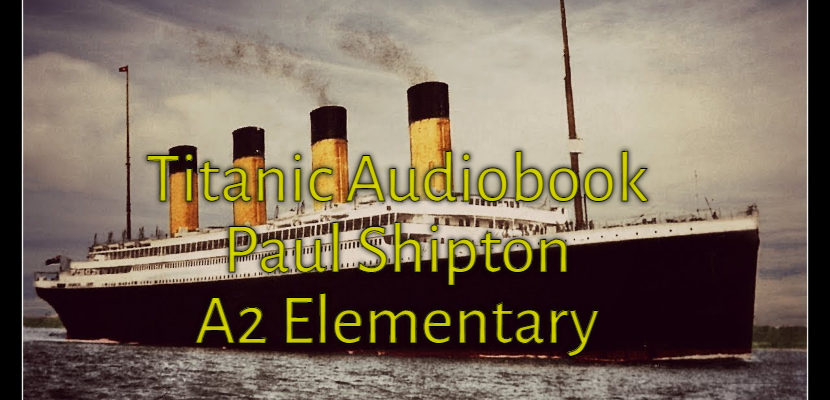
Titanic Audiobook A2 Elementary by Paul Shipton. “Titanic” adapted to English for Level 2 with parallel translation. The story is by English children’s author Paul Shipton.
Titanic audiobook adapted for English level A2. Titanic according to Ilya Frank’s bilingual method. Unique words: 936. Total words: 5822.
## 🚢 Titanic (Audiobook)
📖 Summary (no spoilers)
The Titanic was the biggest and most famous ship of its time. In April 1912, it left England for its first trip across the Atlantic Ocean. Rich and poor people traveled on the ship. They all believed the Titanic was unsinkable. But one cold night, the ship hit an iceberg. This audiobook tells the true story of the Titanic: the passengers, the crew, the terrible disaster, and the famous movie by James Cameron. You will also learn how the wreck was found many years later at the bottom of the ocean.
🎧 Audio Player with Text
The player helps you read and listen at the same time.
Text Area
The sentence you hear now is yellow.
The text moves up when the audio plays. You can always see the yellow sentence.
Select words with your mouse or finger – the audio stops. You can copy the words. Press Play to start again.
Translate Words
You can translate selected text easily.
On a computer, use a browser extension for Chrome.
On an Android phone, use an app like Yandex.Translate or Google Translate.
Just select the text and use your translation tool – the audio stays paused while you translate.
Movie vocabulary (click to open)
Ship (noun) – a large boat that carries people or goods across the sea.
Example: “The Titanic was the biggest ship in the world.”
Ocean (noun) – a very large area of salt water.
Example: “The ship crossed the Atlantic Ocean.”
Passenger (noun) – a person who travels on a ship, train, or plane.
Example: “There were more than 2,200 people on the Titanic.”
Crew (noun) – the people who work on a ship.
Example: “The crew prepared the lifeboats.”
Captain (noun) – the leader of a ship.
Example: “Captain Smith was on the bridge.”
Unsinkable (adjective) – impossible to sink; cannot go under water.
Example: “People called the Titanic the unsinkable ship.”
Iceberg (noun) – a very large piece of ice in the sea.
Example: “The ship hit an iceberg.”
Lifeboat (noun) – a small boat used to save people when a ship sinks.
Example: “There were not enough lifeboats for all the passengers.”
Survivor (noun) – a person who stays alive after a terrible event.
Example: “The Carpathia picked up the survivors.”
Disaster (noun) – a very bad event that causes damage or death.
Example: “The sinking of the Titanic was a terrible disaster.”
Sink (verb) – to go down under water.
Example: “The ship sank in the night.”
Freezing (adjective) – very cold.
Example: “The water was freezing.”
Drown (verb) – to die under water because you cannot breathe.
Example: “Many people drowned in the ocean.”
Rescue (verb/noun) – to save someone from danger.
Example: “The Carpathia came to rescue the passengers.”
Deck (noun) – a floor on a ship.
Example: “Passengers went to the boat deck.”
Radio (noun) – a machine used to send messages over long distances.
Example: “The radio operators sent messages for help.”
Message (noun) – information that you send to someone.
Example: “Phillips sent an SOS message.”
Warning (noun) – something that tells you about danger.
Example: “The ship received ice warnings.”
Bridge (noun) – the place where the captain controls the ship.
Example: “The message was taken to the bridge.”
First class (noun phrase) – the most expensive part of a ship or train.
Example: “Life was very comfortable for first class passengers.”
Third class (noun phrase) – the cheapest part of a ship or train.
Example: “Many third class passengers lost their lives.”
Voyage (noun) – a long trip by ship.
Example: “It was the Titanic’s first voyage.”
Wreck (noun) – the broken remains of a ship that has sunk.
Example: “They found the wreck in 1985.”
Bottom (noun) – the lowest part of something.
Example: “The ship lay at the bottom of the ocean.”
Submarine (noun) – a boat that can travel under water.
Example: “Scientists used a submarine to search the ocean.”
Film (noun/verb) – a movie; to record moving pictures.
Example: “James Cameron filmed the real Titanic.”
Director (noun) – the person who controls the making of a movie.
Example: “James Cameron was the director of Titanic.”
Actor (noun) – a person who plays a part in a movie or play.
Example: “Leonardo DiCaprio played Jack Dawson.”
Actress (noun) – a woman who plays a part in a movie or play.
Example: “Kate Winslet played Rose.”
Memory (noun) – something you remember from the past.